Intermediate Japanese Reading & Communication Class
Read Japanese, understand it,
and talk about it in your own words.
You want to read more Japanese, without worrying about the clock.
You also want to organize your own thoughts and practice discussing them in a group.
This intermediate class builds all four skills — reading, writing, listening, and speaking — including the writing and speaking practice that JLPT prep courses rarely have room for.
Join from Japan or overseas. Two class schedules are available — Morning and Evening — so you can choose a time that fits your location.
Two class times available: Morning & Evening | 2 lessons per week, 60 minutes each | 20 themes total

Free Intermediate Japanese
Reading Practice
Sample PDF
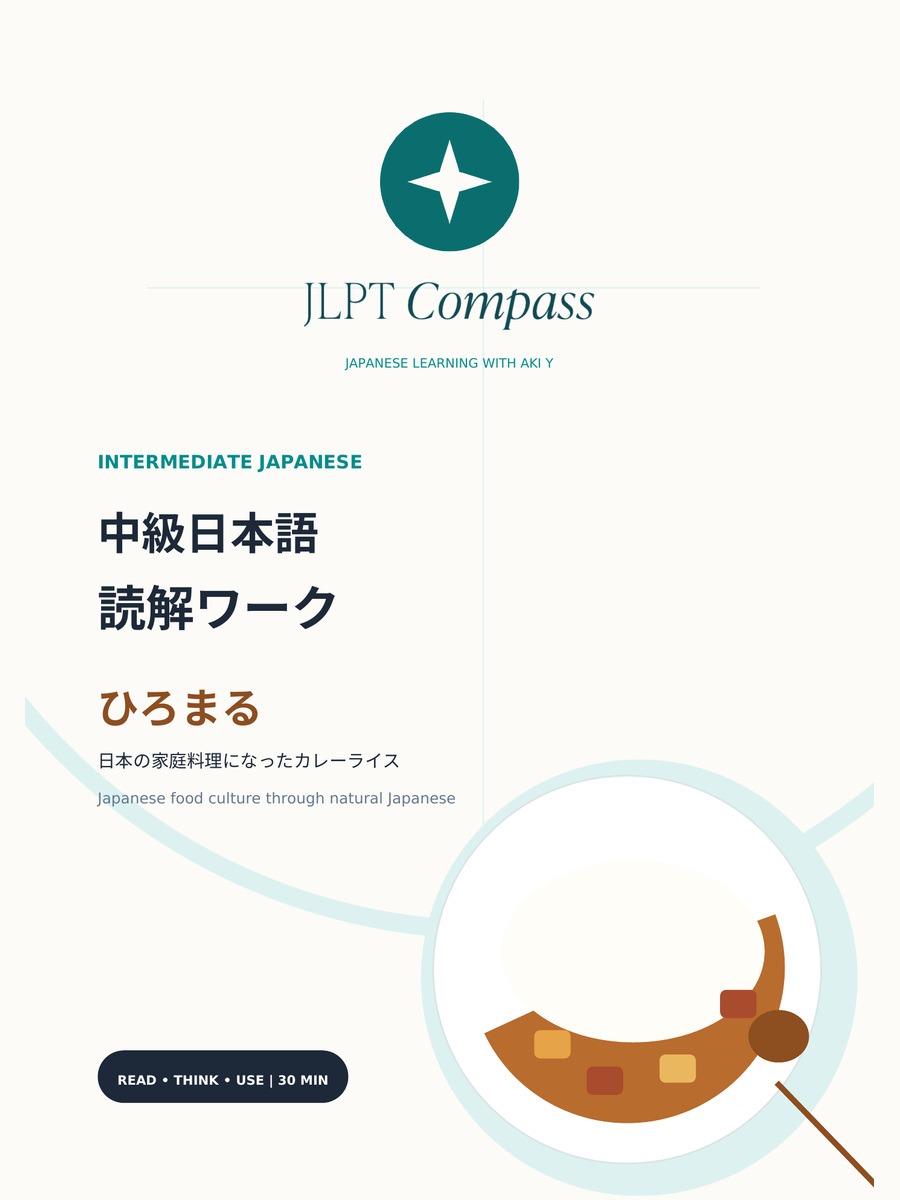
Try a free sample reading passage from our Intermediate Japanese trial lesson material. Practice with the same style of text and questions used in the actual class, and build your reading skills.
Download the Free PDF⚡ Instant access after signup · A sample intermediate-level reading passage
It's not about right or wrong answers —
you want to understand Japanese texts more deeply.
You've studied grammar and vocabulary, and you can read Japanese to some extent. Even so, once a passage gets a little longer, you can lose track of the content partway through — and afterward, if someone asks "what was that about?", it can be hard to explain well.
In everyday life, too, there are plenty of situations where you read newspapers, magazine articles, news, instructions, and notices simply to understand them — not to choose the "correct" answer.
And once you can understand a passage, being able to talk about what you think, and how it connects to your own experience or your own culture, turns reading comprehension into real communication.
Reading Japanese — and going beyond it.
Read passages
in Japanese
In the first session, the goal is to build the ability to read on your own — not just JLPT-style questions, but the kind of Japanese you meet in everyday life. You'll practice tracking how sentences and paragraphs connect, so you can grasp the passage as a whole.
Understand it
more deeply
Instead of racing the clock or chasing a correct answer, you'll read a single passage carefully. Beyond "what does it say," you'll pay attention to how the passage flows, the examples it gives, its reasoning, and the writer's own view.
Talk about
what you read
In the second session, you'll hear other students' views on the passage and share your own thinking. Putting your own experiences and ideas into Japanese words helps you think about the theme even more deeply.
Reading is the core — but all four skills connect.
This isn't a reading class that ends once you finish the passage. For each theme, you'll combine reading, writing, listening, and speaking activities.
Grasp the passage's main idea and read the key parts closely. Pay attention to how sentences and paragraphs connect, and to the writer's own view.
Through grammar, vocabulary, and kanji practice, plus "Summarize It" exercises, you'll organize what you read and what you learned in your own words.
You'll build your listening comprehension by following the teacher's explanations and other students' answers and opinions, with audio materials used as needed.
Through "Answer It" and "Talk About It" activities, you'll share your own experience and thinking about the passage and the theme, in Japanese.
It's not just reading comprehension.
You'll build grammar and vocabulary, too.
Each passage is built around the vocabulary, grammar, and expressions you need at the intermediate level.
After checking meaning and usage within the passage, you'll practice through homework, then review the answers and example sentences together as a class in the next session.
Rather than memorizing grammar and vocabulary in isolation, you'll understand it within real passages, so it becomes Japanese you can actually use when you write and speak.
Two lessons and homework each week, tying all four skills together.
Rather than finishing a theme in a single session, you'll spend a full week working through it.
You read the passage in the first session, organize the content and expressions through homework, then review, present, and discuss it in the second session.
 1
STEP 1 | READ
Read and understand
The first session focuses on reading comprehension of the passage.
- Grasp the passage's main idea
- Read the key parts closely
- Check the writer's view and the flow of the passage
- Check the key vocabulary and expressions
Rather than aiming only for speed or the right answer, you'll take the time to carefully understand the passage's content and background.
 2
STEP 2 | WRITE
Write and organize
Homework fills the gap between the first and second sessions.
- Grammar, vocabulary, and kanji practice
- Work through the "Summarize It" exercise
- Organize what you read, in your own words
- Prepare for "Answer It" and "Talk About It," as needed
Homework here isn't just about solving problems. Writing out what you read and learned, in your own words, builds the writing ability that JLPT prep alone rarely gives you enough practice with.
 3
STEP 3 | LISTEN & SPEAK
Listen, speak, and review
The second session builds on the passage you read and the homework you completed.
- Build short sentences using the grammar and vocabulary
- Think about and answer questions on the passage in "Answer It"
- Share your own thinking on the theme in "Talk About It"
- Listen to other students' answers and opinions
You'll connect what you understood through reading to listening and speaking activities, actually using Japanese in the process. This gives you the time — often limited in JLPT prep — to speak your own thoughts in Japanese and build real conversation skills.
Build the speaking and writing skills
that JLPT prep alone rarely develops.
JLPT prep courses build your ability to answer grammar, vocabulary, reading, and listening questions.
But they rarely give you the chance to put your own thoughts into writing, or to speak your own view after hearing someone else's.
- ◎ Grammar and vocabulary knowledge
- ◎ Ability to answer reading questions
- ◎ Ability to answer listening questions
- ◎ Understanding Japanese passages
- ◎ Summarizing what you read, in your own words
- ◎ Writing sentences using grammar and vocabulary
- ◎ Listening to other students' opinions
- ◎ Speaking your own thoughts on a theme
- ◎ Retaining the grammar and vocabulary learned in class
- ◎ Gradually growing your kanji knowledge
- ◎ Organizing what you read and deepening your own understanding
Recommended too if you want to turn the grammar, vocabulary, and reading skills you built through JLPT prep into real writing and speaking ability.
Course Outline
Course Details
- Online classes via Google Meet
- Small-group format
- 20 themes, 40 sessions total (2 sessions per theme)
- Textbook: An Integrated Approach to Intermediate Japanese (テーマ別 中級から学ぶ日本語)
- Classes are conducted primarily in Japanese
※ Joining partway through, at the start of a new theme, is also possible. See the syllabus below for details.
Class Frequency & Schedules
Class frequency: 2 lessons per week
Lesson length: 60 minutes per lesson
Schedules: Morning Class or Evening Class
Morning: Thursday + Tuesday, 5:30–6:30 AM JST
Evening: Sunday + Friday, 9:00–10:00 PM JST
Both schedules use the same curriculum and learning cycle: Session 1 (Read and understand) → Homework (Write and organize) → Session 2 (Listen, speak, and review).
What You'll Learn
Using passages from An Integrated Approach to Intermediate Japanese, you'll practice reading Japanese writing on Japan-specific culture and modern social themes. Alongside reading comprehension, you'll also work on grammar, vocabulary, expressions, and kanji. Writing exercises using the grammar are given as homework.
20 Themes
Each theme is covered over two sessions: a READ session → homework (Write and organize) → a LISTEN & SPEAK session the following week. Morning Class: Thursday → the following Tuesday. Evening Class: Sunday → the following Friday. See the lesson schedule below for exact dates.
The 20 themes are covered in order, but each one stands on its own, so you don't need to start from Theme 1. You can join from any theme. Because each theme is studied over two lessons, new students normally begin with the READ lesson: Thursday for the Morning Class, or Sunday for the Evening Class.
Choose a Schedule That Works for You
Intermediate Japanese is offered in two time slots with the same curriculum.
Choose the schedule that works best for your location and daily routine. Both classes follow the same weekly learning cycle: READ → WRITE → LISTEN & SPEAK.
Morning Class
Convenient for learners in North America and other regions where Japan's early morning works well.
- Thursday, 5:30–6:30 AM JST
READ — Read & Understand - Tuesday, 5:30–6:30 AM JST
LISTEN & SPEAK — Review, Listen & Discuss
Writing and language practice are completed as homework between the two lessons.
Evening Class
Convenient for learners in Japan, East Asia, Southeast Asia, and South Asia.
- Sunday, 9:00–10:00 PM JST
READ — Read & Understand - Friday, 9:00–10:00 PM JST
LISTEN & SPEAK — Review, Listen & Discuss
Writing and language practice are completed as homework between the two lessons.
Both schedules use the same curriculum, pricing, and learning cycle — they're simply the same course at two different times. Enroll in one schedule: Morning Class or Evening Class.
All times are listed in Japan Standard Time (JST). If you're viewing from abroad, your local time will also be shown based on your browser's time zone.
October–November 2026 Course Schedule
All online · 90 minutes per session · 14 sessions total
N1 Vocabulary
N1 Grammar
N2 Vocabulary
N2 Grammar
N1 Reading
N2 Reading
Intermediate Japanese
Morning Class Schedule
| Week | Theme | Thu (Read) | Tue (Review) |
|---|---|---|---|
| 1 | To Learn ⟨Riddles⟩ | Oct 1 (Thu) | Oct 6 (Tue) |
| 2 | To Discover ⟨Names of Flowers⟩ | Oct 8 (Thu) | Oct 13 (Tue) |
| 3 | To Eat ⟨Feast⟩ | Oct 15 (Thu) | Oct 20 (Tue) |
| 4 | To Use Metaphors ⟨Cast Pearls Before Swine⟩ | Oct 22 (Thu) | Oct 27 (Tue) |
| 5 | To Be Amazed ⟨Packed Train⟩ | Oct 29 (Thu) | Nov 3 (Tue, holiday) |
| 6 | To Convey ⟨Compassion⟩ | Nov 5 (Thu) | Nov 10 (Tue) |
| 7 | To Decorate ⟨Business Cards⟩ | Nov 12 (Thu) | Nov 17 (Tue) |
| 8 | To Be Under the Impression ⟨Men's Colors, Women's Colors⟩ | Nov 19 (Thu) | Nov 24 (Tue) |
| 9 | To Protect ⟨Invisible Opponent⟩ | Nov 26 (Thu) | Dec 1 (Tue) |
| 10 | To Get Used To ⟨Wristwatch⟩ | Dec 3 (Thu) | Dec 8 (Tue) |
| 11 | To Connect ⟨Vertical and Horizontal⟩ | Dec 10 (Thu) | Dec 15 (Tue) |
| 12 | To Classify ⟨A・B・O・AB⟩ | Dec 17 (Thu) | Dec 22 (Tue) |
| 13 | To Recall ⟨The Smell of Noon⟩ | Dec 24 (Thu) | Dec 29 (Tue) |
| — | No class | Dec 31 (Thu) | — |
| 14 | To Reconsider ⟨Teru Teru Bōzu⟩ | Jan 7 (Thu) | Jan 12 (Tue) |
| 15 | To Interact ⟨Travel Bag⟩ | Jan 14 (Thu) | Jan 19 (Tue) |
| 16 | To Sing ⟨The Power of Songs⟩ | Jan 21 (Thu) | Jan 26 (Tue) |
| 17 | To Heal ⟨Life⟩ | Jan 28 (Thu) | Feb 2 (Tue) |
| 18 | To Leave ⟨Hometown⟩ | Feb 4 (Thu) | Feb 9 (Tue) |
| 19 | To Fulfill ⟨Two Dreams⟩ | Feb 11 (Thu, holiday) | Feb 16 (Tue) |
| 20 | To Learn by Heart ⟨Monozukuri⟩ | Feb 18 (Thu) | Feb 23 (Tue) |
※ Dates shown are for October–December 2026 and January–February 2027. No class on December 31 only.
※ November 3 and February 11 are Japanese public holidays, but online classes are held as usual.
Evening Class Schedule
| Week | Theme | Sun (Read) | Fri (Review) |
|---|---|---|---|
| 1 | To Learn ⟨Riddles⟩ | Oct 4 (Sun) | Oct 9 (Fri) |
| 2 | To Discover ⟨Names of Flowers⟩ | Oct 11 (Sun) | Oct 16 (Fri) |
| 3 | To Eat ⟨Feast⟩ | Oct 18 (Sun) | Oct 23 (Fri) |
| 4 | To Use Metaphors ⟨Cast Pearls Before Swine⟩ | Oct 25 (Sun) | Oct 30 (Fri) |
| 5 | To Be Amazed ⟨Packed Train⟩ | Nov 1 (Sun) | Nov 6 (Fri) |
| 6 | To Convey ⟨Compassion⟩ | Nov 8 (Sun) | Nov 13 (Fri) |
| 7 | To Decorate ⟨Business Cards⟩ | Nov 15 (Sun) | Nov 20 (Fri) |
| 8 | To Be Under the Impression ⟨Men's Colors, Women's Colors⟩ | Nov 22 (Sun) | Nov 27 (Fri) |
| 9 | To Protect ⟨Invisible Opponent⟩ | Nov 29 (Sun) | Dec 4 (Fri) |
| 10 | To Get Used To ⟨Wristwatch⟩ | Dec 6 (Sun) | Dec 11 (Fri) |
| 11 | To Connect ⟨Vertical and Horizontal⟩ | Dec 13 (Sun) | Dec 18 (Fri) |
| 12 | To Classify ⟨A・B・O・AB⟩ | Dec 20 (Sun) | Dec 25 (Fri) |
| 13 | To Recall ⟨The Smell of Noon⟩ | Dec 27 (Sun) | Jan 8 (Fri) |
| — | No class | — | Jan 1 (Fri, holiday) |
| 14 | To Reconsider ⟨Teru Teru Bōzu⟩ | Jan 10 (Sun) | Jan 15 (Fri) |
| 15 | To Interact ⟨Travel Bag⟩ | Jan 17 (Sun) | Jan 22 (Fri) |
| 16 | To Sing ⟨The Power of Songs⟩ | Jan 24 (Sun) | Jan 29 (Fri) |
| 17 | To Heal ⟨Life⟩ | Jan 31 (Sun) | Feb 5 (Fri) |
| 18 | To Leave ⟨Hometown⟩ | Feb 7 (Sun) | Feb 12 (Fri) |
| 19 | To Fulfill ⟨Two Dreams⟩ | Feb 14 (Sun) | Feb 19 (Fri) |
| 20 | To Learn by Heart ⟨Monozukuri⟩ | Feb 21 (Sun) | Feb 26 (Fri) |
※ Dates shown are for October–December 2026 and January–February 2027. No class on January 1 (New Year's Day); Theme 13's LISTEN & SPEAK session is moved to January 8.
Pricing
You can start with a single theme, or enroll in the full 20-week course.
For the 20-week course, choose either 7-week installments or a single full payment.
Single Theme
2 × 60-minute lessons
$39
Try one complete theme before deciding whether to continue.
Installments
(every 7 weeks)
$210
(14 lessons)
※ The 3rd payment only is 12 lessons for $170 (total $590, full 20 weeks)
Pay for the first 7 weeks and decide whether you'd like to continue afterward.
Full Payment
(20 weeks)
40 × 60-minute lessons
20 weeks total
$590
Pay in advance for all 20 themes.
Start with One Theme
If you're not sure whether the class level or learning style is right for you, you can begin with one complete theme.
Each theme includes two lessons: READ → homework / WRITE → LISTEN & SPEAK.
After completing the theme, you can decide whether you'd like to continue, and switch to 7-week installments or the full 20-week payment.
※ The same pricing applies to both the Morning and Evening classes.
※ Textbook cost is not included.
※ Payment is planned to be handled via Stripe.
Is This Class Right for You?
- ◎ You want to understand Japanese passages more deeply
- ◎ You want to get closer to Japanese culture and ways of thinking through Japanese texts
- ◎ You want to read real, everyday Japanese — not just JLPT-style texts
- ◎ You want to be able to explain what you read, in your own words
- ◎ You want to build the writing skills that JLPT prep gives you little practice with
- ◎ You want the chance to speak your own thoughts in Japanese
- ◎ You want to actually use the grammar and vocabulary you learned for JLPT, in writing and speaking
- ◎ You want to build reading, writing, listening, and speaking together, in balance
- ◎ You want to keep learning steadily through homework
- ◎ You want to build your Japanese ability, even if the JLPT itself isn't your goal
How to Start Your JLPT Preparation Course
Book a slot on Google Calendar
Pick any open time and book your free consultation instantly.
Online consultation approx. 30 min
We'll check your current Japanese level and learning goals, and let you know whether this class is a good fit.
Enrollment confirmation & payment
Payment via Stripe or PayPal (credit cards accepted).
Preparing for the course
We'll send materials info and anything to prepare in advance.
Google Meet details
We'll send your link ahead of the first session.
Course begins
You're ready to start.
Go beyond simply being able to read Japanese —
build Japanese you can actually use in daily life.
Rather than reading quickly against the clock, the way JLPT prep courses often do, this class is for learners who want to take the time to really read and understand Japanese — and to build grammar and vocabulary through reading passages. You'll also get to practice listening to others' opinions and sharing your own online, building genuinely practical Japanese. Through two lessons and homework each week, you'll build all four skills: reading, writing, listening, and speaking.
See the "Pricing" section above for full details.
Not sure if your current level is a fit? Start with a free online consultation.
Approx. 30 min | We'll check your current level and whether this class fits
Frequently Asked Questions
Questions About Grammar
Questions About Difficulty Level
Rather than simply memorizing grammar or vocabulary, you build the "ability to handle abstract topics" and "logical thinking" needed at the B2 level through the integrated activities of reading, discussing, and writing about a single theme.
Writing exercises using the grammar are given as homework after the first session, then reviewed and corrected in the second session.
Questions About Payment
Start With a Free 30-Minute Online Consultation
Before enrolling, we offer a free 30-minute one-on-one online consultation.
We'll talk through your current Japanese study and goals, and check together whether this class fits your current level.
(No pushy sales — ever.)
Questions? Get in Touch.
If anything about the class is unclear, feel free to reach out.
Please include your name, contact info, and your question.
We typically reply within 2–3 business days.